









Short answer: can CBD cream help with pain or arthritis?
There is some early human research on topical or transdermal CBD in hand and thumb osteoarthritis, but the evidence is still limited and does not prove that ordinary retail CBD creams treat arthritis or pain. A small 2022 randomised controlled trial reported improvements with one specific topical CBD formulation in thumb basal-joint arthritis, while a 2024 open-label feasibility study reported encouraging changes with a transdermal CBD gel. Both studies were small and formulation-specific, so their findings cannot simply be applied to every CBD cream on sale. A cosmetic CBD cream is not a licensed arthritis treatment. If you have persistent joint pain, swelling, stiffness or a diagnosed condition, use appropriate clinical care and speak with a GP, pharmacist or rheumatology professional about treatment decisions.
The science behind CBD and pain research
Cannabidiol, usually shortened to CBD, is one of the naturally occurring cannabinoids associated with Cannabis sativa. Unlike THC, CBD itself is not intoxicating in the same way and does not produce the characteristic cannabis “high”. CBD has attracted research interest because the endocannabinoid system and several other biological pathways are involved in pain signalling, inflammation and sensory processing. However, identifying a plausible biological mechanism is not the same as proving that a finished consumer product produces a clinical benefit. That distinction is particularly important with topicals. A cream, balm, transdermal gel and oral CBD capsule are different formulations with different routes of exposure. Results from one cannot automatically be transferred to another.
What do human studies of topical CBD actually tell us?
There are now a few human studies worth understanding, but the limitations matter as much as the headline result.
| Study | What was tested | What happened | Key limitation |
| Heineman et al., 2022 1 | Topical CBD 6.2mg/ml in shea butter for symptomatic thumb basal-joint arthritis | The small crossover RCT reported improvements in pain and disability measures versus control during the study | Only 18 participants in the randomised phase; one specific formulation and one joint condition |
| Bawa et al., 2024 2 | 4% transdermal CBD gel used three times daily for hand osteoarthritis | 15 participants completed the open-label feasibility study; pain and grip-strength measures improved during treatment | No placebo control; authors state efficacy needs confirmation in a randomised trial |
| Vela et al., 2022 3 | Oral synthetic CBD 20–30mg daily for hand osteoarthritis or psoriatic arthritis | No clinically or statistically significant effect on pain versus placebo | Oral CBD, not a topical cream; useful evidence that results are not uniformly positive across formats |
The useful conclusion is not “CBD works” or “CBD does not work”. It is that the evidence is mixed, still developing and highly dependent on formulation, route and study design.
Why the 2022 topical trial is interesting
The thumb arthritis trial is often cited because it was randomised, double-blind and placebo-controlled with a crossover design. The CBD formulation was applied twice daily for two weeks. Patient-reported pain and disability measures improved during the CBD arm compared with control. That is a legitimate reason for further research, but it was not a trial of every CBD cream sold in the UK. It cannot establish that a different cosmetic formulation, dose or application routine will produce the same result.
What the 2024 hand osteoarthritis study adds
The 2024 feasibility study tested a transdermal 4% CBD gel for four weeks. Participants reported lower pain and showed improvements in grip strength during treatment, with measures trending back towards baseline during washout. CBD and metabolites were also detected at low concentrations in urine, which is important because it shows that assumptions such as “topical CBD never enters the bloodstream” are too absolute. However, the study was open-label and small. The researchers explicitly stated that proof of efficacy requires a placebo-controlled randomised trial.
Topical cream vs transdermal research gel
This distinction is one of the most important things to understand in the evidence. The 2022 thumb-arthritis trial used a specific topical CBD formulation at 6.2mg/ml in shea butter. The 2024 hand-osteoarthritis feasibility study used a 4% transdermal gel designed to move CBD across the skin barrier. Those are not automatically equivalent to one another, and neither is automatically equivalent to a different retail cosmetic cream. A systematic review of topical/transdermal CBD trials found only a small number of eligible human studies and highlighted high risk of bias, formulation differences and weak reporting across the literature. Systematic review of skin-applied CBD trials The useful evidence hierarchy is therefore:
- Exact finished-product trial — strongest relevance to that product.
- Similar route/formulation study — useful context, but not proof of equivalence.
- Different topical/transdermal formulation — hypothesis-generating, not product evidence.
- Oral, animal or laboratory CBD research — increasingly indirect for a retail cream.
That hierarchy helps avoid one of the most common SEO-content errors in this category: citing “CBD research” without checking whether the study actually tested the same route or formulation.
Can CBD cream be advertised as a treatment for arthritis?
Not as an ordinary cosmetic product. The MHRA 4 states that products containing CBD used or marketed for medical purposes are medicines. A product making medicinal claims must meet the applicable medicines rules and, unless exempt, have the appropriate marketing authorisation. That means a cosmetic CBD cream can describe its ingredients, texture, strength, directions and intended body-care or massage routine, but it should not be presented as curing, treating or preventing arthritis, inflammation, nerve pain, sciatica or another disease. Research can be discussed separately from product claims. Findings from a study should not be presented as proof that an ordinary retail cream treats arthritis, inflammation or pain.
Why formulation matters in topical CBD research
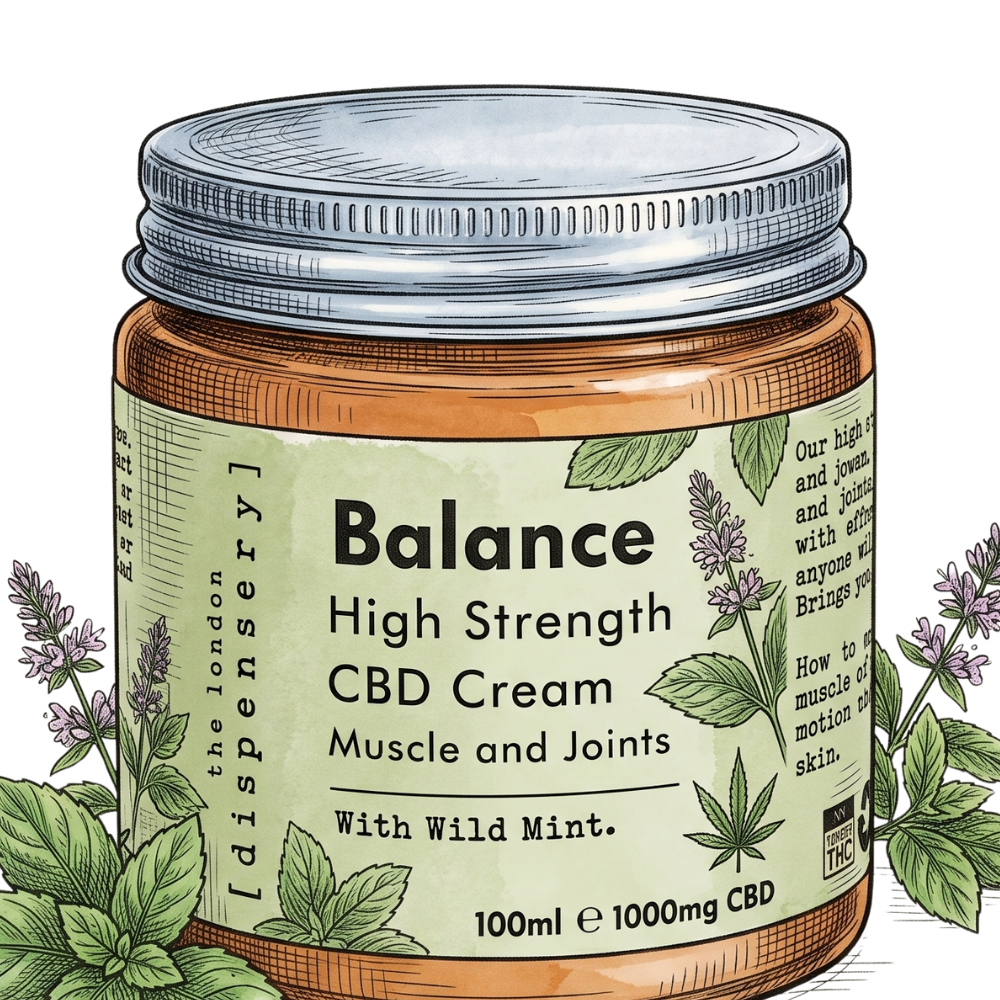
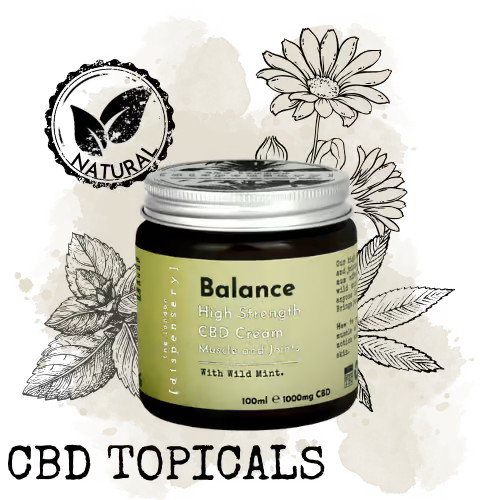
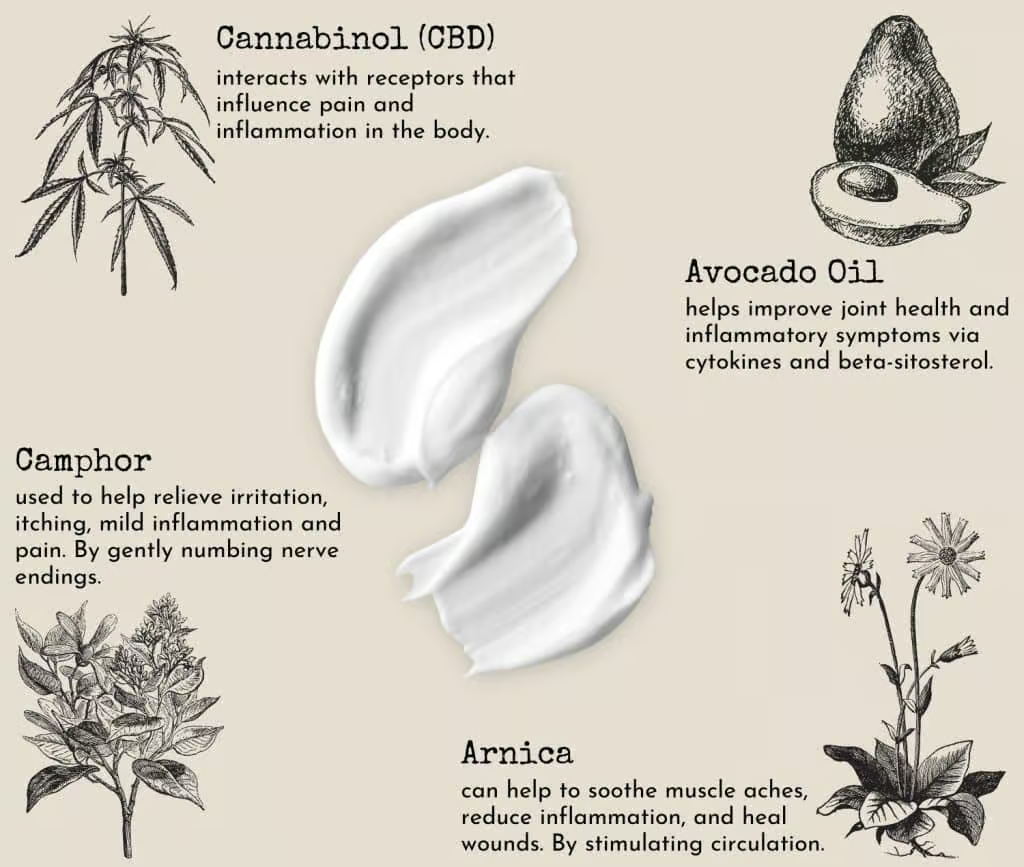
The original article spent useful time on the cream itself, not only the cannabinoid. That material belongs in the retained version because a retail topical is a complete cosmetic formulation. A cream normally combines a water phase with oils, emulsifiers, humectants and other ingredients that determine texture, spread and skin feel. Our current High-Strength CBD Cream uses CBD isolate in a 100ml cream alongside Arnica, Camphor, Wild Mint, Glycerine, Shea Butter and plant oils. Those ingredients explain the formulation; they do not turn evidence from a topical-CBD trial into proof that this finished cosmetic treats pain or arthritis.
Research doses are not product directions
For application, the product label is a better guide than trying to convert research doses into a cosmetic routine. For our 1000mg high-strength CBD cream:
- Start with clean, dry skin.
- Apply a small amount first.
- Massage in comfortable circular movements until absorbed.
- Add more only where needed for the size of the area.
- Reapply only in line with the current product label.
- Patch test before first use.
- Avoid eyes, lips, mucous membranes, and broken or irritated skin.
- Stop use if irritation occurs.
There is no evidence-based rule that a retail CBD cream must be applied morning and night, or that a particular number of milligrams is the “best dose” for arthritis. For procedural questions around amount, application and routine, use the dedicated How to Use CBD Cream guide.
Where to find product specifications
When comparing CBD creams, the most useful questions are practical: how much CBD is in the container, how concentrated the formula is, what else is in it, how it is tested and whether the product information is clear.
1. Compare total CBD with container size
A large milligram number can be misleading without context. A 1000mg cream in 100ml has a nominal concentration of 10mg CBD per ml. Another 1000mg product in a 50ml container would have a different concentration. Use both figures instead of assuming that the largest headline number is automatically the most appropriate product.
2. Read the whole formula
CBD is only one ingredient. Depending on the product, the formula may include plant oils, butter, wax, glycerine, essential oils or botanical extracts such as Arnica. Our High-Strength CBD Cream includes Arnica, Camphor, Wild Mint, Shea Butter, Glycerine and several plant oils alongside CBD isolate. Those ingredients help define the cream’s texture, aroma and skin feel. Their presence is not evidence that the finished cosmetic treats arthritis.
3. Check lab information and traceability
Look for clear cannabinoid information and accessible third-party testing. The London Dispensary publishes CBD lab reports separately so customers can inspect cannabinoid verification rather than relying solely on marketing copy.
4. Check the safety directions
A topical should tell you where it can be used, whether a patch test is advised, what areas to avoid and what to do if irritation occurs.
5. Compare price in context
Price should be assessed alongside container size, CBD content, ingredient quality, formulation and testing. Expensive does not automatically mean effective, and cheap does not automatically mean poor. The useful question is whether the product specification supports the price being charged.
Why topical formats cannot be treated as interchangeable
A cream and balm are not simply different names for the same thing.
| CBD cream | CBD balm |
| Contains a water phase and tends to feel lighter | Usually richer in oils, butters and waxes |
| Generally easier to spread across a larger area | Often suited to a slower, richer massage over a smaller area |
| May absorb with a lighter finish | Usually leaves a more occlusive feel |
If texture is your main question, read What Are CBD Topicals? CBD Creams & Balms Explained. If you prefer a richer format, compare our warming 500mg CBD muscle balm.
Why format still matters outside the research
For many people, the appeal of a cream is practical: it is familiar, easy to spread and simple to add to an external body-care or massage routine. A lighter cream can be convenient for shoulders, back, arms, legs, hands or feet. Someone may prefer that texture after exercise, physical work, a shower or a long day. These are routine-based use cases rather than medical indications.
What about exercise, physiotherapy and other arthritis care?
If the reason you are searching for CBD cream is persistent joint pain or stiffness, the most important information is still the evidence-based care for the underlying condition. The NHS 5 6 notes that treatment for osteoarthritis can include regular exercise, maintaining a healthy weight where relevant, medicines, physiotherapy and other supportive treatments. Topical NSAIDs can be effective for osteoarthritis in some joints, and capsaicin cream may be considered in certain circumstances. Rheumatoid arthritis requires its own medical management and may involve disease-modifying medicines. A CBD cosmetic should not replace prescribed medication, physiotherapy or medical assessment. If pain or swelling is worsening, recurring, affecting sleep or daily activities, or has not improved, seek professional advice.
When to seek medical advice
See a healthcare professional if you have persistent or unexplained joint pain, significant swelling, a hot joint, loss of movement, prolonged morning stiffness or symptoms affecting daily life. Seek urgent medical help for a hot swollen joint accompanied by fever or feeling acutely unwell.
Want to compare the cream itself?
If you are comparing the product itself rather than the research, our High-Strength CBD Cream page contains the complete 1000mg specification, ingredients, directions, testing information and current price. That keeps the product specification in one place while this guide stays focused on the research, limitations and practical context.
Frequently Asked Questions
Does topical CBD treat arthritis?
Early research exists, but ordinary retail topical CBD products are not proven or licensed arthritis treatments.
What did the 2022 topical CBD trial find?
A small randomised crossover trial in thumb basal-joint arthritis reported improvements with one specific topical CBD formulation, but the study was small and formulation-specific.
What does the 2024 transdermal CBD study add?
A small open-label hand-osteoarthritis study reported encouraging changes, but there was no placebo control and the authors said efficacy needs confirmation in a randomised trial.
Can findings from one topical CBD study be applied to every product?
No. Results depend on formulation, route, dose and study design and cannot automatically be transferred to an ordinary retail cosmetic.
Can a cosmetic topical CBD product be marketed as treating pain or arthritis?
Not without the applicable medicines authorisation. Medical treatment claims can bring a CBD product within medicines regulation.
Where can I compare The London Dispensary CBD cream?
Use the dedicated High-Strength CBD Cream product page for the 1000mg specification, ingredients, directions, testing information and current price.
References and further reading
- Heineman JT et al. A Randomized Controlled Trial of Topical Cannabidiol for the Treatment of Thumb Basal Joint Arthritis. Journal of Hand Surgery, 2022
- Bawa Z et al. An open-label feasibility trial of transdermal cannabidiol for hand osteoarthritis. Scientific Reports, 2024
- Vela J et al. Cannabidiol treatment in hand osteoarthritis and psoriatic arthritis: randomized placebo-controlled trial. Pain, 2022
- NHS: Arthritis
- NHS: Osteoarthritis — treatment and support
- MHRA statement on products containing cannabidiol
- Heineman JT et al. A Randomized Controlled Trial of Topical Cannabidiol for the Treatment of Thumb Basal Joint Arthritis. Journal of Hand Surgery, 2022. https://pubmed.ncbi.nlm.nih.gov/35637038/
- Bawa Z et al. An open-label feasibility trial of transdermal cannabidiol for hand osteoarthritis. Scientific Reports, 2024. https://pubmed.ncbi.nlm.nih.gov/38783008/
- Vela J et al. Cannabidiol treatment in hand osteoarthritis and psoriatic arthritis: randomized placebo-controlled trial. Pain, 2022. https://pubmed.ncbi.nlm.nih.gov/34510141/
- MHRA statement on products containing cannabidiol. https://www.gov.uk/government/publications/mhra-statement-on-products-containing-cannabidiol-cbd/mhra-statement-on-products-containing-cannabidiol-cbd
- NHS: Osteoarthritis — treatment and support. https://www.nhs.uk/conditions/osteoarthritis/treatment/
- NHS: Arthritis. https://www.nhs.uk/conditions/arthritis/