















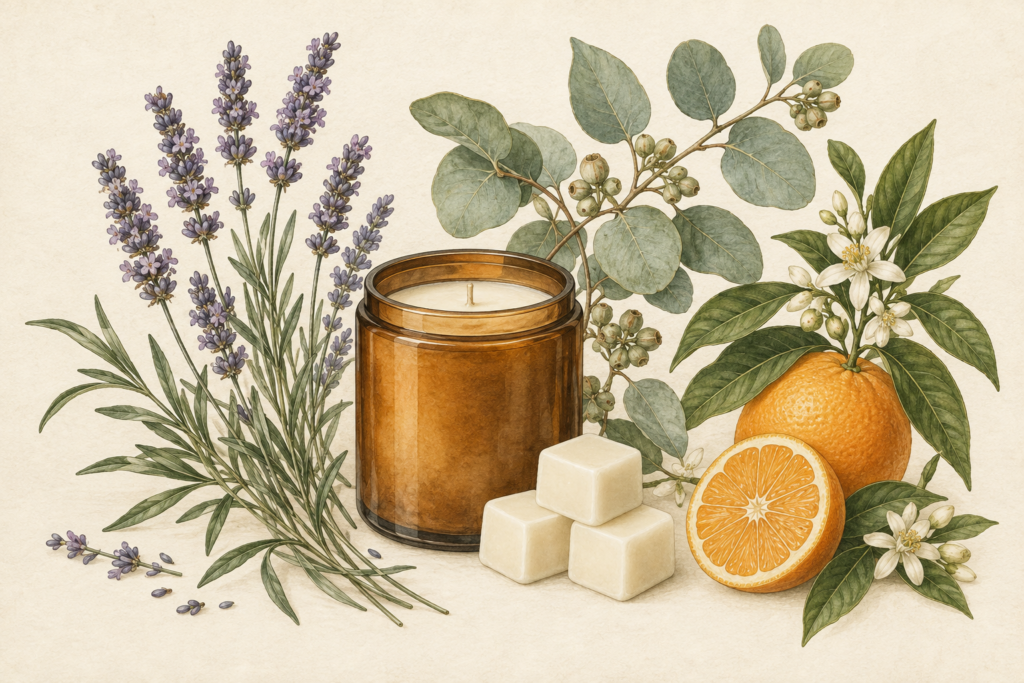
Essential oil candles are a way to bring botanical fragrance into a room. If you are choosing one, the most useful question is not which oil promises the biggest benefit, but which scent you will actually enjoy living with. A bright citrus blend, a lavender-led floral fragrance and a warm, spiced candle can create very different atmospheres.
At The London Dispensary, we developed our original candle range around layered essential-oil blends rather than a single overpowering note. This guide explains five of the oils we use, how their fragrances work together, and what to look for when buying an aromatherapy candle. It also separates the practical benefits of a well-made candle from the health claims that home fragrance cannot substantiate.
What Is an Essential Oil Candle?
An essential oil candle is a scented candle in which plant-derived essential oils form part of the fragrance. The wax, wick, vessel and fragrance formulation all affect how it burns and how the scent develops. An essential oil is not the same thing as a finished candle: an oil that smells attractive from the bottle will not necessarily perform in every wax or at every concentration.
Essential oils contain mixtures of aromatic compounds, including terpenes and other constituents. Their composition helps explain why different plants have recognisable scents, but it does not mean that burning a candle delivers a therapeutic dose of those compounds. For more on the chemistry, see our guide to terpenes.
DID YOU KNOW?
Five Essential Oils We Like in Candles
These are five scent directions, not a ranking of medical effectiveness. Each can be used alone or as part of a professionally formulated blend, and the best choice depends on your preference.
1. Sweet Orange — Bright and Juicy
Sweet orange brings a recognisable, fresh citrus character. It is a useful opening note when a blend needs brightness without becoming entirely floral or herbal. Lemon, grapefruit and bergamot offer different variations on the citrus family, but they are not interchangeable in every formulation.
Our Grounding blend pairs Sweet Orange and Bergamot with Frankincense and Indian Ginger. The citrus makes the first impression, while the resinous and spicy notes give it more depth. It is a good direction for someone who wants a fresh fragrance with a warmer finish.
2. Lavender — Floral and Herbal
Lavender is familiar, but it does not have to smell like a single-note lavender sachet. Its floral-herbal character works particularly well with other soft florals and a small amount of spice.
In Slumber, we combine Lavender with Clary Sage, Ylang Ylang and Nutmeg. The result is an evening-style fragrance with a floral opening and a warmer base. You can enjoy it as part of a bedtime routine, but the candle is not a treatment for insomnia and does not guarantee better sleep. The ASA distinguishes acceptable fragrance and wellbeing language from medicinal claims that require appropriate authorisation.1
3. Peppermint — Cool and Fresh
Peppermint has a distinctive cool, minty aroma. In a home-fragrance blend, it can make citrus and herbal notes feel sharper and fresher. We use it in Breathe alongside Lemongrass, Eucalyptus and Tea Tree, giving the blend a crisp, botanical character.
That scent association is different from a medical effect. A peppermint candle should not be presented as clearing blocked airways, treating a cold or providing pain relief. Choose it because you enjoy the fragrance, not as a substitute for treatment.
4. Ylang Ylang — Rich, Sweet Florals
Ylang Ylang has a rich floral scent with a slightly tropical character. It can add softness and depth to a blend, especially when combined with lavender and herbal notes. We use it in Slumber to round out the floral side of the fragrance before the warmer Nutmeg note comes through.
It is also a useful reminder that more fragrance is not always better. A rich floral scent may be beautiful in a small quantity and overpowering in a large room-filling dose. The finished candle should be balanced for its wax, wick and vessel rather than simply loaded with as much oil as possible.
5. Nutmeg — Warm and Gently Spiced
Nutmeg adds a warm, softly spicy note. It is not the loudest part of our Slumber blend, but it gives the fragrance a more rounded finish. In other fragrance styles, spice can work alongside citrus or resinous notes to create a more autumnal or winter-like character.
As with all essential oils, the fact that Nutmeg is plant-derived does not make it suitable for every use or every person. A candle is a formulated home-fragrance product; its oil blend should not be copied into food, bath water or a skin preparation.
Choosing by Fragrance Rather Than a Promised Effect
| Fragrance direction | What to expect | Our blend |
|---|---|---|
| Citrus, resin and spice | Bright opening with a warmer finish | Grounding |
| Fresh citrus and herbs | Crisp, minty and botanical | Breathe |
| Floral and gently spiced | Soft florals with a warmer base | Slumber |
The three blends and their ingredients are described on our candle collection and individual product pages. Check the current listing for the exact formulation, size and availability before ordering.2
Essential Oils vs Fragrance Oils: Is Natural Always Better?
No. Essential oils are plant-derived; fragrance oils may contain synthetic and/or natural aromatic ingredients. That distinction tells you something about the source of the fragrance, but it does not establish that one finished candle is automatically safer, healthier or more environmentally sustainable than another.
Natural fragrance ingredients can cause allergic reactions too. Candle safety depends on the complete formulation, the concentrations used and the way the product is made and labelled. UK product-safety guidance specifically requires manufacturers to assess candle formulations and their fragrance hazards.3
MYTH BUSTER
What Makes a Good Essential Oil Candle?
Wax and wick
Vegetable waxes such as soy, coconut and rapeseed can be used in candle making, alone or in blends. Different waxes and wicks affect appearance, scent performance and burning behaviour. There is no single wax that is automatically best for every essential oil.
When developing our original range, we worked with a coconut, soy and rapeseed blend and tested how the fragrance performed in the finished candle. The lesson worth keeping is that the whole formulation matters. A high oil percentage on its own is not a quality guarantee, and an old test result should not be treated as the specification of every current batch.
Fragrance strength and scent throw
Cold throw is the scent you notice before lighting; hot throw is the fragrance you notice while the candle is burning. A good candle should be pleasant in both states, but the ideal strength depends on the blend and the space. A smaller room may need less fragrance than an open-plan living area.
If you are making candles yourself, use materials intended for candle manufacture, follow the wax and fragrance suppliers’ limits and test the complete formulation. Do not assume that the old 8–10% figure from our original article is a universal recommendation. Adding extra essential oil to a finished candle can change its burning behaviour and is not a safe shortcut to stronger scent.
Vessel, burn time and presentation
Look for a heat-suitable vessel, clear care instructions and a realistic estimated burn time. Our original candles were developed as small, lidded jars, but current dimensions and burn estimates belong on the individual product page rather than being repeated as a fixed specification in an evergreen guide.
For gifting, the presentation matters too. A candle should arrive protected, with its safety information intact, and the recipient should be able to identify the scent without needing to understand the chemistry behind it.
How to Burn an Essential Oil Candle Safely
Place it on a stable, heat-resistant surface, away from draughts, curtains and other flammable materials. Follow the manufacturer’s wick-care and maximum-burn instructions. Never leave a flame unattended, move a candle while it is lit or allow it to burn while anyone is asleep. Keep it out of reach of children and pets, and allow the vessel to cool before handling it. These precautions follow UK fire-service guidance.4
Do not add loose dried botanicals, extra oil or other materials to the wax. If you notice unusual smoking, a very large flame or damage to the vessel, extinguish the candle safely and stop using it. A candle is not intended for ingestion, inhalation as a dosing method or application of melted wax to the skin.
TOP TIP
Explore Our Botanical Home Fragrance
Three Fragrance Directions, One Collection
Explore our aromatherapy candles and choose between the citrus-and-spice Grounding blend, fresh botanical Breathe and floral-spiced Slumber. For a wick-free alternative, browse aromatherapy wax melts. The wax melt gift set with burner is another option when you want to explore several scents.
Our current candle range includes CBD as part of the formulation. If you want to understand what that means, read our CBD and hemp candles guide. We do not present burning a candle as a way to absorb CBD.
For other ways to enjoy botanical fragrance, explore the aromatherapy collection, including roll-ons and bath products. These are separate formats with different directions; essential oils should not be transferred between them without an appropriate formulation.
For ingredient-led guidance on choosing a scent for your routine, read Essential Oils for Sleep, Essential Oils for Stress & Everyday Calm, Essential Oils for Energy.
Frequently Asked Questions
Frequently Asked Questions
Which essential oils are best for candles?
It depends on the scent you enjoy. Sweet Orange offers bright citrus, Lavender a floral-herbal character, Peppermint a fresh minty note, Ylang Ylang rich florals and Nutmeg gentle spice. The finished blend and candle formulation matter more than any single oil.
Are essential oil candles better for you than fragrance oil candles?
Not automatically. Plant-derived and synthetic fragrance ingredients can both present hazards. Choose a properly formulated candle with clear safety information rather than assuming natural means harmless.
How much essential oil should I put in a candle?
There is no universal percentage. Follow the wax and fragrance suppliers' instructions and test the complete formulation. Do not add extra oil to a finished candle or use an old brand-specific test figure as a general recipe.
Can I mix essential oils to make a candle fragrance?
Yes, but a candle blend must be formulated and tested for the intended wax and wick. A mixture that smells pleasant in a bottle is not automatically suitable for burning.
Do essential oil candles help you sleep?
A fragrance may be enjoyable as part of an evening routine, but a candle is not a treatment for insomnia or a guarantee of better sleep. Always extinguish it before going to bed.
References
- Advertising Standards Authority. Health: Aromatherapy. 9 October 2024. ASA guidance.
- The London Dispensary. CBD Candles collection and individual fragrance listings. Candle collection.
- Business Companion. Candles, diffusers, oil heaters, etc. Product-safety guidance.
- London Fire Brigade. Candles – Fire safety at home. Candle safety.