













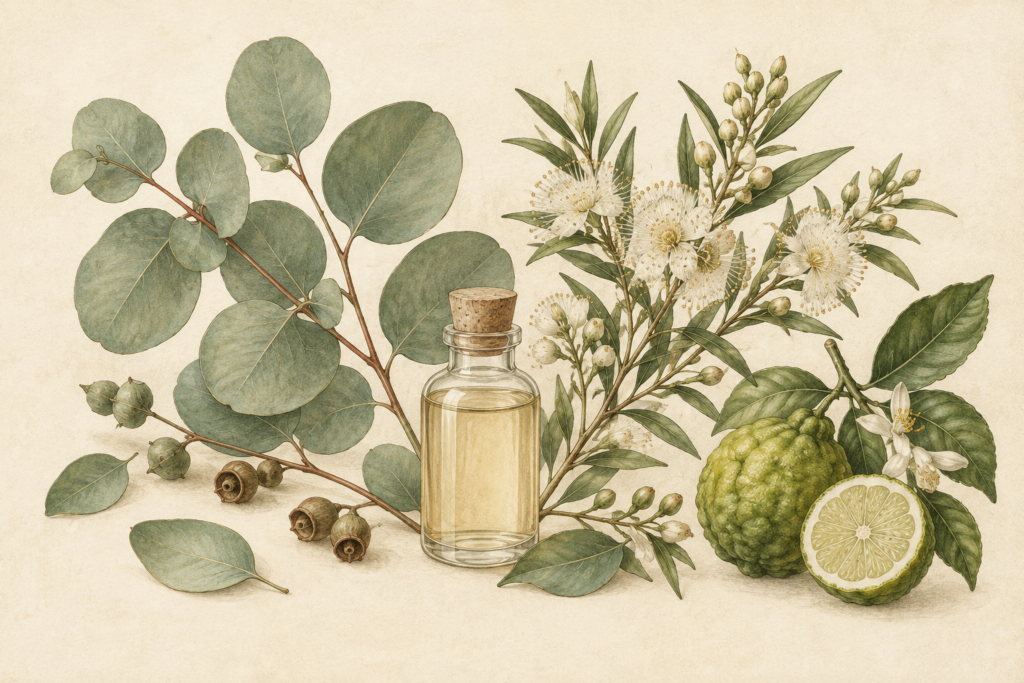
Essential oils are concentrated aromatic materials obtained from plants. They can give a candle its citrus opening, a wax melt its herbal character or a ready-diluted roll-on its distinctive scent. They are also easy to misunderstand: an essential oil is not the same as a fragrance oil, carrier oil or finished aromatherapy product.
This practical essential oils guide explains the differences, how to read a label and how to choose a format you can use safely. If you want to start with finished products, explore our aromatherapy collection, including candles, wax melts and roll-ons formulated for their intended use.
What Are Essential Oils?
An essential oil is a volatile mixture of aromatic compounds obtained from botanical material. “Volatile” means the compounds evaporate readily, which is why you can smell them. Different oils may be produced from flowers, leaves, peel, wood, roots or resin, and the plant part matters.
The word “essential” refers to the plant’s characteristic essence or aroma; it does not mean the oil is essential to health. Essential oils contain many naturally occurring chemicals, including terpenes. Our guide to terpenes explains that chemistry without turning it into a list of promised effects.
How Are Essential Oils Made?
Steam distillation
Steam passes through plant material and carries volatile aromatic compounds with it. The vapour is cooled, allowing the essential oil and aromatic water to separate. Lavender, rosemary and eucalyptus oils are commonly produced by distillation.
Expression
Citrus peel oils are often obtained by mechanical expression rather than distillation. The aromatic material is released from the peel, then separated from the juice and water.
Extraction method is useful product information, but it is not a quality score by itself. The botanical species, plant part, storage and finished formulation all contribute to how an oil smells and performs.
Essential Oil, Fragrance Oil, Carrier Oil or CBD Oil?
| Product | What it is | Typical role |
|---|---|---|
| Essential oil | Concentrated plant-derived aromatic material | A fragrance ingredient used within a suitable formulation |
| Fragrance oil | A natural, synthetic or mixed fragrance composition | Scenting a finished consumer product |
| Carrier oil | A non-volatile vegetable oil, such as sunflower or jojoba | Diluting aromatic ingredients in a topical formula |
| CBD oil | A carrier oil formulated with cannabidiol | A separate product category with its own directions |
MYTH BUSTER
How to Read an Essential-Oil Label
Look for the common name and botanical name, such as Lavandula angustifolia for one type of lavender. A useful label or product page should also identify the plant part, extraction method where relevant, quantity, directions, warnings and responsible business.
Botanical names reduce ambiguity because common names can cover more than one species. They do not, however, prove purity, ethical sourcing or a particular therapeutic effect. Treat unsupported phrases such as “therapeutic grade” as marketing unless the seller explains the underlying standard.
How to Judge Essential-Oil Quality Without Falling for Marketing Myths
“Therapeutic grade”, “medical grade” and similar phrases are widely used in essential-oil marketing, but they are not a universal independent quality standard. More useful information includes the botanical name, ingredient declaration, intended use, batch or traceability information where supplied, responsible packaging and clear safety directions.
Price alone is not proof of quality either. Some oils are naturally expensive because of plant yield and production method, while others are abundant. Compare like with like and judge the finished product on whether its specification makes sense for the way it will actually be used.
Choose by Scent, Then by Format
Start with the fragrance you enjoy. Citrus oils tend to smell bright and zesty; lavender and ylang ylang sit in the floral family; eucalyptus, rosemary and peppermint are fresh and herbal; cedar and frankincense are woody or resinous; ginger and nutmeg bring warmth and spice. Our home-fragrance scent guide explores these families in more detail.
Candles and wax melts
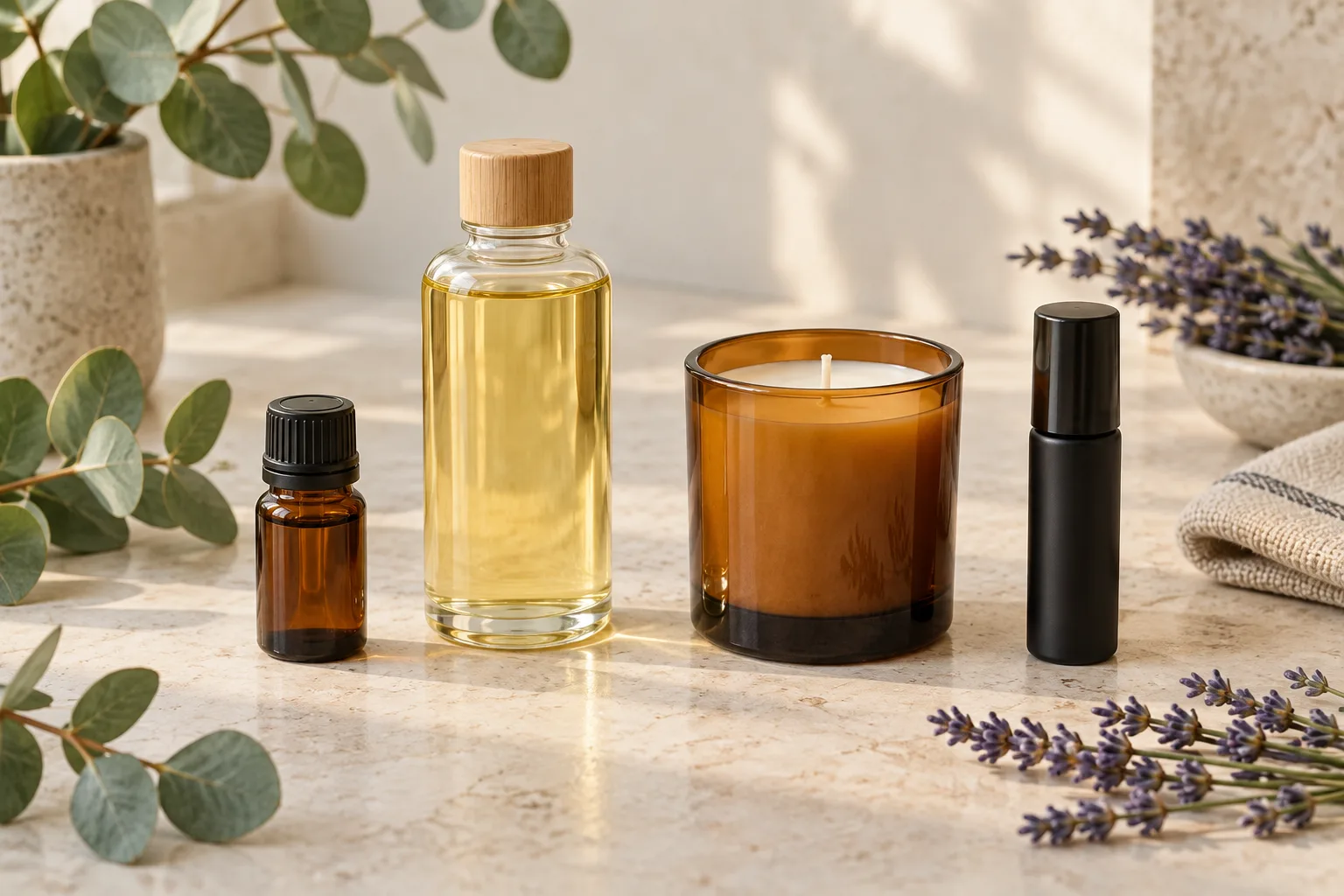
In home fragrance, the oil is one part of a finished wax formulation. The wax, wick or warmer, fragrance concentration and safety testing all matter. Do not add neat essential oil to a finished candle or old wax melt. Compare our aromatherapy candles and aromatherapy wax melts, then follow the instructions supplied with the product.
Diffusers and room fragrance
Use only a diffuser-compatible product in the amount specified by its manufacturer. Water, neat oil and formulated diffuser liquid are not interchangeable. Ventilate the room and stop use if the fragrance is uncomfortable.
Ready-diluted roll-ons
A finished roll-on combines aromatic ingredients with a suitable base for topical use. Follow its label and patch-test instructions. Do not assume a neat oil can be used on skin simply because the same botanical appears in a ready-diluted product. Browse our aromatherapy roll-ons for portable, pre-formulated options.
Essential-Oil Safety at Home
Use each finished product only as directed. Keep concentrated oils away from eyes, broken skin, flames and heat, and do not ingest them unless the product is specifically sold and labelled for that purpose. Store bottles closed, upright, away from sunlight, children and pets.
UK product-safety guidance requires sellers of candles, diffusers and aromatic oil heaters to assess the finished product, provide appropriate instructions and consider fragrance hazards and sensitising ingredients.1
Children, pets and fragrance-sensitive people may need extra care. Do not rely on a general internet list of “safe” oils: species, concentration, route and the individual animal or person all matter. Ask an appropriate healthcare professional or veterinary professional if you are unsure.
A 2025 systematic review of essential oils in dermatological and cosmetic applications also illustrates why formulation matters: different oils, concentrations and finished formats produced different safety and efficacy findings. That evidence should not be reduced to “natural = safe” or “essential oil = therapeutic”.2
TOP TIP
Essential Oils and Health Claims
A scent can be described as bright, fresh, floral or suited to an evening ritual. That is different from claiming it treats anxiety, insomnia, respiratory illness or another condition. The ASA requires objective health claims to be supported and says medicinal claims are not permitted for unlicensed aromatherapy products.3
Three Botanical Fragrance Directions
Find the scent that suits your space
Grounding layers Sweet Orange and Bergamot with Frankincense and Ginger. Breathe combines Lemongrass, Eucalyptus, Tea Tree and Peppermint for a crisp herbal profile. Slumber blends Lavender, Clary Sage, Ylang Ylang and Nutmeg for a softer floral-spiced scent.
Explore these blends across our aromatherapy collection. The names describe fragrance directions and routines, not medical outcomes.
For ingredient-led guidance on choosing a scent for your routine, read Essential Oils for Sleep, Essential Oils for Stress & Everyday Calm, Essential Oils for Energy.
Frequently Asked Questions
Frequently Asked Questions
What are essential oils?
Essential oils are concentrated aromatic materials obtained from botanical material, commonly by steam distillation or expression.
Can you apply essential oils directly to skin?
Do not assume a neat essential oil is suitable for direct skin use. Choose a finished topical product formulated for that purpose and follow its label and patch-test directions.
What is the difference between an essential oil and a fragrance oil?
An essential oil is obtained from botanical material. A fragrance oil can contain natural aromatic ingredients, synthetic ingredients or both. The complete finished formulation determines how it should be used.
Can you put essential oils in candles or wax melts?
Only use aromatic materials intended for that formulation and follow supplier limits and appropriate testing. Do not add neat oil to a finished candle or an old wax melt.
How should essential oils be stored?
Keep bottles tightly closed, upright and away from sunlight, heat, children and pets. Follow any storage directions on the product.
References
- Business Companion. Candles, diffusers, oil heaters, etc. Last reviewed May 2024. Product-safety guidance.
- Pezantes-Orellana C, Bermúdez FG, Montalvo J, et al. Evaluating efficacy, safety, and innovation in skin care applications of essential oils: a systematic review. Front Med. 2025;12:1589691. PubMed.
- Advertising Standards Authority. Health: Aromatherapy. 9 October 2024. ASA guidance.