










Which essential oils are good for stress and calm? Lavender and Bergamot appear frequently in aromatherapy research, while citrus, Eucalyptus, Peppermint and other botanical scents are often chosen because of the atmosphere people associate with them. But there is an important line between an enjoyable calming fragrance and a claim that an oil treats anxiety.
That line matters for both credibility and compliance. Aromatherapy studies have reported some encouraging stress and anxiety outcomes, but the evidence is heterogeneous and often uses specific clinical settings, doses and delivery methods. A candle or rollerball sold for everyday wellbeing is not automatically equivalent to an intervention tested in a trial.
This guide looks at the evidence, the scent profiles people often choose for a calmer setting, and how to build a simple Balance-style routine around room fragrance or a portable roll-on without turning it into a medical promise.
Does Aromatherapy Actually Reduce Stress?
There is some human evidence, but it should be described carefully. A systematic review and meta-analysis of randomised clinical trials in healthy adults found a favourable effect of aroma inhalation on self-reported stress, while the cortisol analysis did not reach statistical significance. The authors described the overall evidence as limited because the number, size and quality of trials were low.1
A much larger 2023 systematic review looked at inhalation aromatherapy for stress and anxiety in clinical settings. It included 76 studies with 6,539 patients and reported positive anxiety findings in many trials, but the authors also highlighted substantial heterogeneity, bias, inconsistent plant-species reporting and limited safety data.2
That gives us a sensible middle position: aromatherapy is not evidence-free, but the research does not justify saying that every Lavender candle or Eucalyptus roll-on “treats anxiety”.

MYTH BUSTER
What Does the ASA Allow Aromatherapy Brands to Say?
The Advertising Standards Authority says objective health claims for aromatherapy need robust documentary evidence, where relevant including human trials. It also reminds marketers that medicinal claims are not permitted for unlicensed products. The guidance is more accepting of modest wellbeing language — for example, helping someone relax or de-stress — than claims to treat a diagnosed condition.3
That is the standard we use here. “Fresh”, “calming atmosphere”, “evening ritual” and “a moment to pause” describe a sensory experience. “Treats anxiety” is a different kind of claim.
Essential Oils Commonly Chosen for Calm and Relaxation
Lavender — Familiar Floral-Herbal Calm
Lavender has one of the broadest research profiles in aromatherapy and is strongly associated with evening and relaxation products. Its scent is floral but also distinctly herbal, which means it can work in a soft bedroom blend or as a contrast to fresher ingredients.
Research interest does not make every Lavender product equivalent. A Lavender pillow mist, a topical oil and a candle all expose the user differently and have different safety requirements.
Bergamot — Bright Citrus with a Softer Edge
Bergamot sits in the citrus family but often smells less sharply “lemony” than Lemon itself. It is useful when you want a brighter fragrance that still feels rounded and slightly floral.
Our Grounding home-fragrance blend pairs Bergamot with Sweet Orange, Frankincense and Indian Ginger. That combination is best understood as a citrus, resin and warm-spice fragrance rather than a clinical stress intervention.
Eucalyptus — Fresh, Green and Botanical
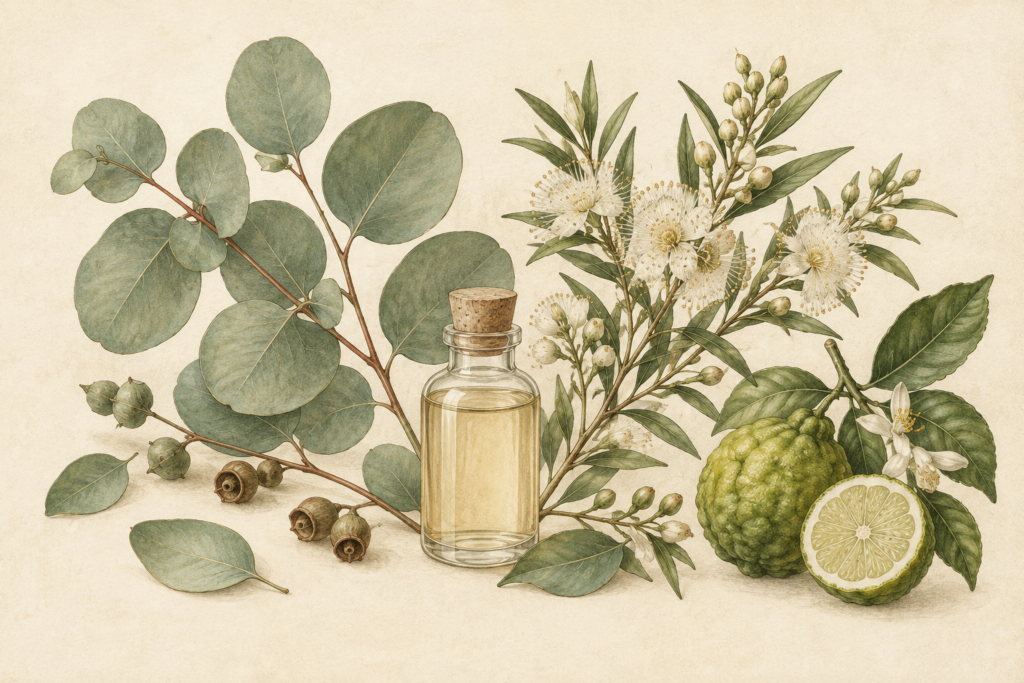
Eucalyptus gives a clean, penetrating botanical note. It is often associated with spas and “fresh air” fragrance profiles, although a home-fragrance product should not be described as clearing airways or treating respiratory symptoms.
In our Balance roll-on, Eucalyptus is paired with Tea Tree. In the Breathe candle and wax-melt fragrance, it appears with Lemongrass, Tea Tree and Peppermint.
Tea Tree — Sharp, Herbal and Clean-Smelling
Tea Tree has a distinctive medicinal-herbal aroma. That description refers to how it smells, not to a medicinal claim for a candle or rollerball. It gives the Balance roll-on and Breathe home-fragrance blend a fresher, less floral direction.
Citrus Oils — Brightness Rather Than Sedation
Sweet Orange, Lemon and Bergamot are useful when “calm” for you does not mean sleepy. Some people prefer a lighter fragrance while reading, stretching or taking a break during the day. A calm routine can be bright and fresh rather than heavy and floral.
What About Essential Oils for Anxiety?
This is where wording matters most. A 2023 network meta-analysis included 44 randomised controlled trials involving 3,419 participants and compared several essential oils used in anxiety research.4
That is genuine clinical literature. It does not mean an ordinary retail aromatherapy candle, wax melt or roll-on is an authorised treatment for an anxiety disorder. Trial populations, delivery methods, doses and outcome measures differ, and anxiety requiring clinical care should not be reduced to choosing a scent.
If somebody is experiencing persistent or severe anxiety, aromatherapy can sit alongside an ordinary wellbeing routine if they enjoy it, but it should not replace appropriate medical or psychological support.
Build a Calm Routine by Format
| Format | How it fits | TLD example |
|---|---|---|
| Roll-on | Portable topical fragrance for a short pause during the day | Balance — Eucalyptus & Tea Tree |
| Candle | Room fragrance while reading, stretching or winding down | Breathe — Lemongrass, Eucalyptus, Tea Tree & Peppermint |
| Wax melts | Same home-fragrance idea in a warmer, useful when you like changing scent | Breathe wax-melt fragrance family |
| Warmer citrus/resin fragrance | For people who prefer a reading-room or living-room scent over a spa-like fresh profile | Grounding — Sweet Orange, Bergamot, Frankincense & Indian Ginger |
The Balance Roll-On: A Portable Scent Routine
Our Balance Eucalyptus & Tea Tree CBD Roll-On is a 10ml external-use rollerball containing 500mg CBD isolate. The useful feature here is format: it is already formulated for topical application and can live in a bag or desk drawer.
We do not describe pulse points as a special bloodstream-delivery pathway and we do not present the product as treating stress or anxiety. If you want the practical application guidance, read How to Use an Aromatherapy Roll-On.
Breathe Candle and Wax Melts: Fresh Room Fragrance
The Breathe Eucalyptus & Lemongrass CBD Candle combines Lemongrass, Eucalyptus, Tea Tree and Peppermint in a 120ml vegan vegetable-wax candle with 100mg CBD isolate.
It is a fresh, citrus-herbal fragrance. That makes it suitable for a living room, yoga space or quiet break if you enjoy sharper botanical scents. It should not be sold as opening airways, treating anxiety or delivering CBD through inhalation.
If you prefer a wick-free format, browse the aromatherapy wax melts. Our Wax Melts vs Candles guide explains the practical difference.
Grounding: When “Calm” Means Warm Rather Than Fresh
Not everybody associates relaxation with Lavender or Eucalyptus. Our Grounding Orange & Bergamot CBD Candle uses Sweet Orange, Bergamot, Frankincense and Indian Ginger for a warmer citrus-resin fragrance.
It is useful to include here because calm is partly preference. One person may associate a crisp Eucalyptus blend with a reset; another may prefer Orange, resin and spice while reading. Neither preference needs a clinical explanation.

TOP TIP
A Simple Five-Minute Aromatherapy Pause
- Change the context: step away from the screen or task if you can.
- Choose one scent: use a roll-on as directed or fragrance the room with a candle/wax melt while you remain present.
- Do something ordinary: make tea, stretch, read two pages or sit without another task competing for attention.
- Keep the claims modest: the ritual can be pleasant without needing to be a treatment.
- Use the format safely: extinguish flames before leaving the room and follow topical-product directions.
A routine like that is useful because it is repeatable and easy to understand. The fragrance marks the pause; it does not need to carry the whole burden of stress management.
Essential-Oil Safety Still Matters in “Calming” Products
Plant-derived does not mean irritation-free. Neat essential oils are concentrated materials and should not automatically be applied directly to skin. For topical use, choose a finished product formulated and labelled for that purpose.
For candles and wax melts, do not add extra essential oil to the finished wax. Follow the manufacturer’s directions and keep flames away from children, pets and flammable materials. London Fire Brigade advises never leaving candles or oil burners unattended.5
Explore Calm & Balance Aromatherapy
Choose by Format and Scent
Portable: Balance Eucalyptus & Tea Tree CBD Roll-On.
Fresh room fragrance: Breathe Eucalyptus & Lemongrass CBD Candle or the matching wax-melt family.
Warm citrus/resin: Grounding Orange & Bergamot CBD Candle.
Wider range: browse Calm & Balance products or the wider aromatherapy collection.
The Bottom Line
Essential oils are interesting for stress and calm because there is a real human research literature, not because every wellbeing claim made about them is proven. The evidence contains encouraging signals but also heterogeneity, small studies and product-to-product differences.
For everyday use, the more useful approach is to choose a fragrance you genuinely like, put it into a short repeatable routine, and keep the language honest. A candle can make a room feel different. A rollerball can be a portable scent cue. Neither needs to be called an anxiety treatment to be worthwhile.
This article provides general information about aromatherapy and wellbeing. It is not a treatment guide for anxiety or another medical condition.
Frequently Asked Questions
Frequently Asked Questions
Which essential oils are commonly used for stress and relaxation?
Lavender, Bergamot and several citrus or herbal oils are commonly used in relaxation-focused aromatherapy. Research has reported some positive stress and anxiety signals, but studies vary substantially and no retail aromatherapy product should be treated as a guaranteed treatment.
Do essential oils treat anxiety?
Essential oils have been studied in anxiety research, including randomised trials, but a retail candle, wax melt or roll-on should not be marketed as treating an anxiety disorder. The ASA requires objective health claims to be supported by robust evidence and restricts medicinal claims for unlicensed products.
Is Lavender or Bergamot better for calm?
There is no universal best oil. Lavender is floral-herbal and has a relatively broad research base; Bergamot is a brighter citrus note and has also been studied. Choose by scent preference and finished-product format rather than assuming one oil will produce a guaranteed emotional effect.
Can I use an aromatherapy roll-on when I feel stressed?
A ready-formulated roll-on can be used as a portable scent-led routine according to its label. It should not be described as treating anxiety or stress, and neat essential oil should not automatically be applied directly to skin.
What TLD products fit a calm or Balance aromatherapy routine?
The Balance roll-on uses Eucalyptus and Tea Tree in a 10ml external-use format, while Breathe candles and wax melts use Lemongrass, Eucalyptus, Tea Tree and Peppermint for a fresh botanical room fragrance. The Calm & Balance collection brings together relevant products without claiming that the fragrances treat anxiety.
References
- Hur M-H, Song J-A, Lee J, Lee MS. Aromatherapy for stress reduction in healthy adults: a systematic review and meta-analysis of randomized clinical trials. Maturitas. 2014;79(4):362-369. https://pubmed.ncbi.nlm.nih.gov/25234160/
- Hedigan F, et al. Benefit of inhalation aromatherapy as a complementary treatment for stress and anxiety in a clinical setting – A systematic review. Complement Ther Clin Pract. 2023;52:101750. https://pubmed.ncbi.nlm.nih.gov/37031643/
- Advertising Standards Authority. Health: Aromatherapy. 9 October 2024. https://www.asa.org.uk/advice-online/health-aromatherapy.html
- Essential oils for treating anxiety: a systematic review of randomized controlled trials and network meta-analysis. https://pubmed.ncbi.nlm.nih.gov/37325306/
- London Fire Brigade. Candles – Fire safety at home. https://www.london-fire.gov.uk/safety/the-home/candles/