















Which essential oils are best for sleep? Lavender is the obvious place to start, partly because it has the strongest recognition in bedtime aromatherapy and partly because it has actually been studied in people. But a useful bedtime fragrance guide needs to go further than a list of oils and a promise that they will “make you sleep”.
Sleep is affected by light, routine, stress, temperature, caffeine, medication, health conditions and plenty more. An essential-oil fragrance can sit inside an evening routine, but it is not a substitute for treating persistent insomnia. The interesting question is therefore not “which oil knocks you out?” but which scents suit an evening setting, what does the research actually show, and which format fits your routine?
This guide looks at Lavender, Clary Sage, Ylang Ylang and other bedtime-style fragrance directions, then compares candles, wax melts, roll-ons and pillow sprays. If you want the broader introduction to extraction, labels and safe use first, read our practical essential oils guide.
Does Lavender Essential Oil Help with Sleep?
Lavender is one of the better-studied aromatherapy ingredients in relation to sleep. A 2026 systematic review and meta-analysis included 11 randomised controlled trials involving 628 adults. The pooled analysis reported an improvement in sleep-quality measures with Lavender essential-oil interventions.1
That is more meaningful than saying Lavender is “traditionally relaxing”, but it still needs context. The trials used different populations, delivery methods and study designs. They do not establish that every Lavender product produces the same result, nor do they prove that a Lavender candle treats insomnia.

MYTH BUSTER
Why Scent Can Still Be Useful in a Bedtime Routine
A repeated evening routine can help separate the end of the day from the rest of it. Fragrance is one sensory cue you can build into that routine: the same candle while reading, the same pillow mist before turning the lights down, or the same roll-on used while getting ready for bed.
That is deliberately modest language. The Advertising Standards Authority says objective health claims for aromatherapy require robust evidence, and unlicensed products cannot make medicinal claims. Wellbeing language around relaxing or winding down is much easier to justify than claiming a product treats anxiety or insomnia.2
Four Essential-Oil Directions for an Evening Fragrance
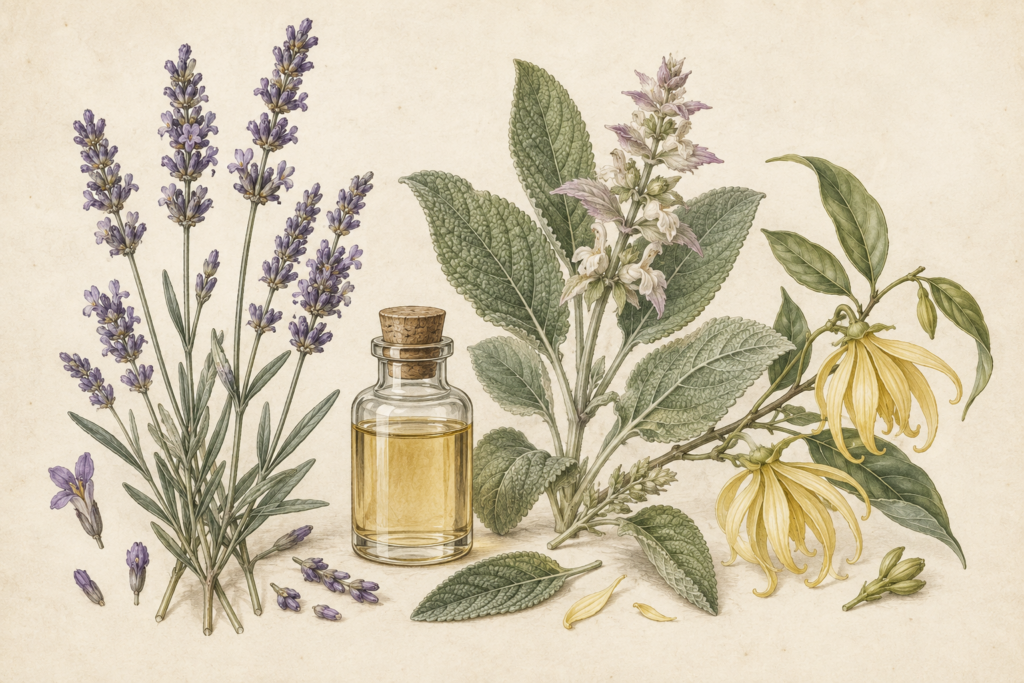
1. Lavender — Floral, Herbal and Familiar
Lavender sits at the centre of most bedtime aromatherapy because its scent is immediately recognisable and the human sleep literature is comparatively developed. It works well alone, but in home fragrance it can also be softened with other florals or warmed with a small amount of spice.
Our Slumber fragrance starts with Lavender but does not stop there. The candle combines Lavender with Clary Sage, Ylang Ylang and Nutmeg, creating a floral-herbal opening with a warmer base. The Slumber Lavender Sleep Candle is the candle-format expression of that blend.
2. Clary Sage — Herbal and Softly Green
Clary Sage has a softer, slightly earthy herbal profile that works naturally alongside Lavender. In a blend, it can stop Lavender becoming too sweet or one-dimensional.
There is research interest around Clary Sage and mood or stress, but those studies do not justify turning every Clary Sage home-fragrance product into a therapeutic claim. In our range it is best understood as part of the scent architecture of Slumber.
3. Ylang Ylang — Richer Floral Depth
Ylang Ylang adds a fuller, sweeter floral note. Used sparingly, it gives a Lavender-led blend more body and can make it feel less like a single-note botanical fragrance.
It is a good example of why “best essential oils for sleep” lists can be too simplistic. The amount, the other notes around it and the finished format all change how a fragrance feels in a room.
4. Nutmeg — Warm Spice for the Base
Nutmeg brings gentle warmth rather than another floral layer. In Slumber, it works as the base note that rounds out Lavender, Clary Sage and Ylang Ylang. We use it because of the way the scent develops, not because a candle flame turns Nutmeg into a medicine.
What About Eucalyptus and Rosemary at Bedtime?
Not every evening product needs to smell purely floral. Our Lavender & Eucalyptus Pillow Spray combines Lavender and Eucalyptus with Clary Sage and Rosemary in a 50ml, CBD-free textile mist.
That gives it a fresher profile than Slumber. The point is not that Eucalyptus or Rosemary “make you sleep”; it is that some people prefer a clean botanical fragrance on bed linen rather than a warm candle scent.
The product uses an alcohol-free witch-hazel base and is intended for suitable textiles according to its directions. Keep that format distinction clear: a pillow spray is not a skin oil, and a roll-on is not a room spray.
Candle, Wax Melt, Roll-On or Pillow Spray?
| Format | Best suited to | Important point |
|---|---|---|
| Candle | Room fragrance, candlelight and an evening ritual while you are awake | Extinguish before bed; never leave unattended |
| Wax melt | Changing fragrance easily with a compatible warmer | Tea-light burners still use a flame; electric warmers still become hot |
| Roll-on | Portable, ready-formulated topical fragrance | Use only on intact skin as directed; do not treat pulse points as a special systemic-delivery route |
| Pillow spray | Bed linen and suitable textiles | Follow textile directions and allow the mist to settle/dry as instructed |
If you want the detailed candle version of this question, our separate sleep candle guide owns candle-specific buying and safety intent. For wax-melt handling, use How to Use Wax Melts.
Build a Bedtime Aromatherapy Routine Around the Format You Actually Like
You do not need every format at once. A simple routine is often easier to maintain:
- Earlier in the evening: use a candle or wax melt while reading, bathing or getting ready for bed.
- Before the lights go out: extinguish any candle or tea-light burner completely.
- At the bedside: use a pillow spray on suitable textiles if that is part of your routine.
- For a portable option: use a ready-formulated roll-on according to its label rather than handling neat essential oil.
Our Bed Lavender & Camphor CBD Roll-On is the portable option in that group. It contains 500mg CBD isolate in a 10ml external-use rollerball. The Lavender/Camphor profile is different from the Slumber candle blend, so it should not be treated as the same fragrance in another container.

TOP TIP
Why We Do Not Recommend Sleeping with a Candle Burning
A sleep candle is a candle for an evening setting, not a candle to burn while you are asleep. London Fire Brigade advises that candles and oil burners should never be left unattended and should be put out before bed.3
That safety point is important enough to be boring about. If you tend to fall asleep while reading or watching television, choose a format that does not rely on an open flame for that part of the routine.
Do More Essential Oils Make a Better Sleep Blend?
No. A longer ingredient list is not evidence of better sleep. In fragrance formulation, every additional note changes the balance. Four well-matched notes can be more coherent than ten oils chosen because each one appears on a “best for sleep” list.
The same applies to concentration. More essential oil is not automatically better or safer. Finished candles, wax melts and topical blends need to be formulated for their specific use rather than strengthened by adding extra neat oil at home.
What Should You Look for When Buying Bedtime Aromatherapy?
- Clear fragrance notes: know what the product is actually supposed to smell like.
- Correct format: room fragrance, textile mist and topical rollerballs need different formulations and directions.
- Realistic claims: “evening”, “wind-down” and “bedtime fragrance” are not the same as treating insomnia.
- Safety information: candles need fire-safety instructions; topical products need skin-use directions; sprays need textile-use guidance.
- Useful product detail: size, fragrance ingredients, wax/formulation information and clear care instructions are more useful than a giant list of promised benefits.
Explore the Bedtime Aromatherapy Formats
Build the Routine by Format
Candle: Slumber Lavender Sleep Candle — Lavender, Clary Sage, Ylang Ylang and Nutmeg in a 120ml vegan vegetable-wax candle with 100mg CBD isolate.
Wax melts: browse the aromatherapy wax melts collection if you prefer a warmer and changeable fragrance.
Roll-on: Bed Lavender & Camphor CBD Roll-On — a 10ml external-use rollerball with 500mg CBD isolate.
Pillow spray: Lavender & Eucalyptus Pillow Spray — a 50ml CBD-free textile mist with Lavender, Eucalyptus, Clary Sage and Rosemary.
Or browse the wider Bedtime & Sleep range.
The Bottom Line on Essential Oils for Sleep
Lavender has enough human research behind it to make the subject more interesting than pure fragrance folklore. The 2026 meta-analysis is encouraging, but it does not turn every Lavender-scented product into a clinically proven sleep aid.
For a TLD-style bedtime routine, the practical approach is simpler: choose an evening fragrance you enjoy, use the right format safely, keep medical claims separate from aromatherapy evidence, and make the scent one repeatable part of winding down.
This article provides general information about aromatherapy and fragrance, not medical advice or treatment for insomnia.
Frequently Asked Questions
Frequently Asked Questions
What essential oil is most commonly used for sleep?
Lavender is the most commonly researched and used essential oil in bedtime aromatherapy. A 2026 systematic review and meta-analysis of 11 randomised trials found an overall improvement in adult sleep-quality measures, but the studies used different populations and methods and should not be read as proof that any Lavender candle or retail product treats insomnia.
Can essential oils cure insomnia?
No ordinary aromatherapy product should be presented as a treatment or cure for insomnia. Persistent sleep problems should be discussed with an appropriate healthcare professional. Essential oils may be used as part of a bedtime fragrance routine, but product-specific medical claims require appropriate evidence and authorisation.
Is a candle, wax melt, roll-on or pillow spray best for bedtime?
There is no universal best format. Candles and wax melts fragrance the room, a roll-on is a ready-formulated topical product and a pillow spray is used on suitable textiles according to its directions. Choose the format you enjoy and can use safely.
Can you leave a sleep candle burning overnight?
No. Extinguish candles and tea-light burners before bed or whenever you leave the room. London Fire Brigade advises never leaving candles or oil burners unattended.
What is in The London Dispensary Slumber fragrance?
The Slumber candle and matching fragrance family use a floral and gently spiced profile built around Lavender, Clary Sage, Ylang Ylang and Nutmeg. The fragrance is positioned for an evening setting rather than as a treatment for insomnia.
References
- Shen H, Zhang L-J, Zhu W-Y. The Sleep-Enhancing Effect of Lavender Essential Oil in Adults: A Systematic Review and Meta-Analysis. Holist Nurs Pract. 2026;40(2):105-118. https://pubmed.ncbi.nlm.nih.gov/40600743/
- Advertising Standards Authority. Health: Aromatherapy. 9 October 2024. https://www.asa.org.uk/advice-online/health-aromatherapy.html
- London Fire Brigade. Candles – Fire safety at home. https://www.london-fire.gov.uk/safety/the-home/candles/